What Is CIN (Corporate Identification Number)
Starting a company in India involves several registrations and compliance requirements. One of the most important identifiers assigned to a company after incorporation is the Corporate Identification Number or CIN. This unique number helps regulators, investors, financial institutions, and other stakeholders identify and track a company throughout its lifecycle. Since incorporation records are often reviewed during financial assessments, maintaining proper company documentation can also support applications for a business loan
What is a CIN Number?
A Corporate Identification Number (CIN) is a distinctive alphanumeric code consisting of 21 characters that is assigned to companies registered in India by the Registrar of Companies (ROC) under the Ministry of Corporate Affairs (MCA). It serves as a company's official identity for regulatory and compliance purposes.
A company's legal identity and compliance records often play an important role when applying for external funding. Many lenders review incorporation details and regulatory documentation while evaluating applications for a business loan.
However, Limited Liability Partnerships (LLPs) are not issued a CIN. Instead, they receive an LLPIN (Limited Liability Partnership Identification Number).
CIN Number Example
To understand the structure better, let's look at a CIN number example:
L01245MH2010PTC089453
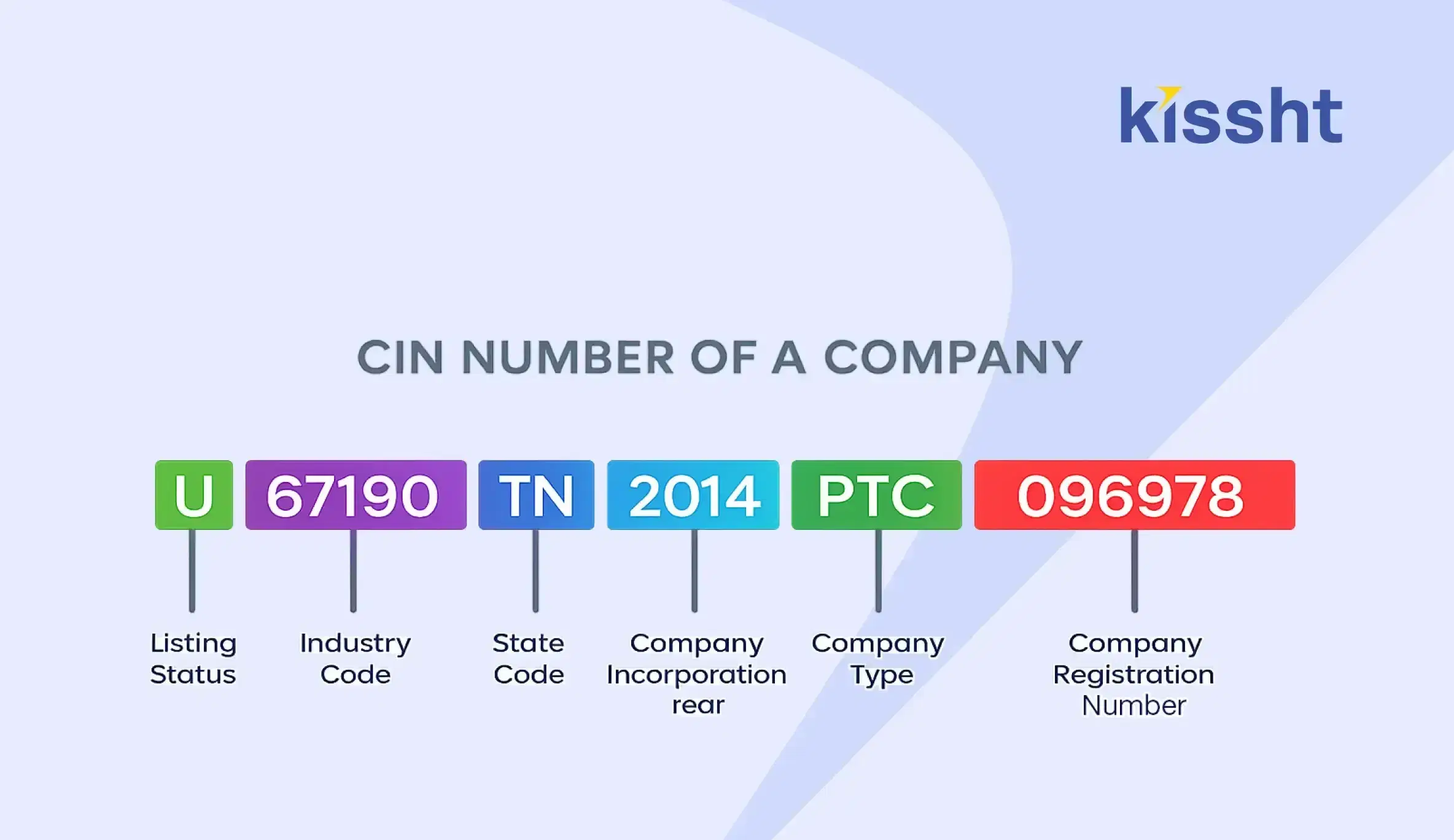
This unique code contains specific information about the company, including its listing status, industry, state of registration, year of incorporation, company type, and registration number.
Understanding the Structure of a CIN Number
| Section | Example | Meaning |
|---|---|---|
| 1st Character | L | Listed or Unlisted Status |
| Next 5 Digits | 01245 | Industry Classification |
| Next 2 Letters | MH | State of Registration |
| Next 4 Digits | 2010 | Year of Incorporation |
| Next 3 Letters | PTC | Company Category |
| Last 6 Digits | 089453 | ROC Registration Number |
What Do the Common CIN Abbreviations Mean?
| Abbreviation | Meaning |
|---|---|
| PTC | Private Limited Company |
| PLC | Public Limited Company |
| OPC | One Person Company |
| GOI | Government of India Company |
| SGC | State Government Company |
| NPL | Section 8 (Not-for-Profit) Company |
| FTC | Subsidiary of Foreign Company |
These abbreviations help identify the legal structure of the company.
How to Check a CIN Number?
If you want to perform a CIN number check, the Ministry of Corporate Affairs provides an online facility.
Step 1:
Visit the MCA portal and open the "Find CIN" service.
Step 2:
Choose the option to search using the company name.
Step 3:
Enter the company name and complete the captcha verification.
Step 4:
Submit the details to view the company's information, including its CIN number.
This is the easiest method for conducting a CIN number check online.
How to Obtain a CIN Number?
The process of CIN number registration begins when a company is incorporated through the Ministry of Corporate Affairs.
Step 1:
Reserve the company name through the SPICe+ application.
Step 2:
Obtain Digital Signature Certificates (DSC) and Director Identification Numbers (DIN).
Step 3:
Complete the company incorporation application.
Step 4:
Submit Memorandum of Association (MOA) and Articles of Association (AOA).
Step 5:
Upload all required incorporation documents.
Step 6:
Submit the application after paying the registration fees.
Once approved, the ROC issues the Incorporation Certificate containing the company's Corporate Identification Number.
Completing the incorporation process helps establish a formal business identity. As businesses grow, digital platforms such as the Kissht app have made access to various financial services more convenient for eligible enterprises.
Why is a CIN Number Important?
The CIN plays a critical role in company identification and compliance. It helps regulatory authorities track a company's activities from incorporation onwards. The number also provides quick information about the company's legal status, industry classification, state of registration, and incorporation details. Additionally, it serves as a unique identifier in various regulatory filings and official documents. Businesses planning to grow often evaluate funding requirements in advance, and many use a business loan calculator to estimate repayment obligations before making borrowing decisions.
Where is a CIN Number Used?
Companies are required to mention their CIN on several official documents.
These include:
- Invoices and bills
- Letterheads
- Notices
- Annual reports
- Audit reports
- MCA filings
- Official company publications
Failure to mention the CIN where required can result in penalties. Today, several business-related services are available digitally. Platforms such as the Kissht app have simplified access to financial solutions for eligible businesses through online processes.
Penalty for Not Mentioning CIN
Companies must display their CIN on specified documents as required under company law.
Failure to comply may attract a penalty of ₹1,000 per day for the company and every officer in default. The maximum penalty can go up to ₹1,00,000.
Can a CIN Number Change?
Although the CIN generally remains constant, certain business changes may lead to modifications.
A CIN may change if:
- The company's listing status changes
- The registered office shifts to another state
- The company's industry classification changes
In such situations, the relevant sections of the CIN are updated accordingly.
CIN vs GSTIN
| Particulars | CIN | GSTIN |
|---|---|---|
| Full Form | Corporate Identification Number | Goods and Services Tax Identification Number |
| Issued By | MCA | CBIC |
| Purpose | Company Identification | Tax Identification |
| Structure | 21 Characters | 15 Characters |
| Used For | Compliance and ROC Filings | GST Returns and Tax Transactions |
A CIN identifies the company, while GSTIN identifies the business for taxation purposes.
CIN vs PAN
| Feature | CIN | PAN |
|---|---|---|
| Purpose | Company Identification | Tax Identification |
| Issuing Authority | MCA | Income Tax Department |
| Applicable To | Companies | Individuals and Entities |
| Format | 21-character Code | 10-character Code |
| Usage | Corporate Compliance | Tax Filings and Financial Transactions |
Both identifiers serve different purposes and are essential for business operations.
Business Financing and Company Registration
A properly registered business with complete compliance records often finds it easier to access formal financing. Many lenders evaluate company documentation and legal registration status while assessing eligibility for a business loan.
Digital platforms such as the Kissht app also provide financial solutions for eligible borrowers seeking business funding. When comparing options, businesses should evaluate interest rates, repayment flexibility, and choose a suitable business loan provider based on their requirements.
Conclusion
The Corporate Identification Number (CIN) is one of the most important identifiers assigned to a registered company in India. It helps regulatory authorities, investors, lenders, and other stakeholders identify and verify company information quickly. Understanding its structure, purpose, and usage can help businesses maintain compliance and operate more efficiently within India's corporate framework.
FAQs
Q1. What is the CIN number of a company?
The Corporate Identification Number is a unique 21-character code issued by the Registrar of Companies to every registered company in India. It serves as the company's official identity for legal and compliance purposes.
Q2. How can I perform a CIN number check online?
You can perform a CIN number check through the MCA portal by searching for the company name under the "Find CIN" service.
Q3. Is a CIN number mandatory for all companies?
Yes. Every company registered under the Companies Act receives a CIN number and must use it in prescribed official documents and filings.
Q4. Is CIN the same as GSTIN?
No. The Corporate Identification Number identifies a company, while GSTIN is used for GST-related tax compliance and transactions.
Q5. Can a CIN number be changed?
Yes. A CIN may change if there is a change in listing status, state of registration, or industry classification of the company.





Instant Loans at Your Fingertips


Personal Loan
Fast, hassle-free loan for your personal needs.

Business Loan
Fuel your business growth with quick approvals.

Loan Against Property
Unlock your property’s value with ease.

Credit Pulse
Boost your credit score with smart insights.

Track your credit score
Simply enter your mobile number to get a quick overview of your credit score.
Check Now

Related articles

Jun 6, 2026
Top safest cars in India: 5-Star NCAP Rated Models

May 22, 2026
Learners Licence Test Questions and Answers 2026

Jun 7, 2026
Pradhan Mantri Awas Yojana Eligibility: Who Can Apply in 2026?

Jun 8, 2026
What to Gift Your Father on Father's Day 2026: Thoughtful Gift Ideas for Every Budget

Feb 23, 2026
How to Apply Electric Vehicle Subsidy in India 2026: Eligibility, Amount & Process

May 26, 2026
Diwali 2026: Date, Puja Muhurat & Lakshmi Puja Timing

May 25, 2026
Ganesh Chaturthi Holiday 2026: Date and Puja Muhurat Details
May 26, 2026
आधार कार्ड कैसे डाउनलोड करें? सबसे आसान तरीका

May 24, 2026
Money Saving Tips - List of Ways to Save Money Every Month

May 25, 2026
Best Tourist Places in India 2026

May 23, 2026
Best Cars Under 5 Lakh in 2026: Affordable Yet Reliable Options

May 25, 2026